What the Slab Knows: Forensic Surveys That Reveal a Building's Secrets Before You Sign
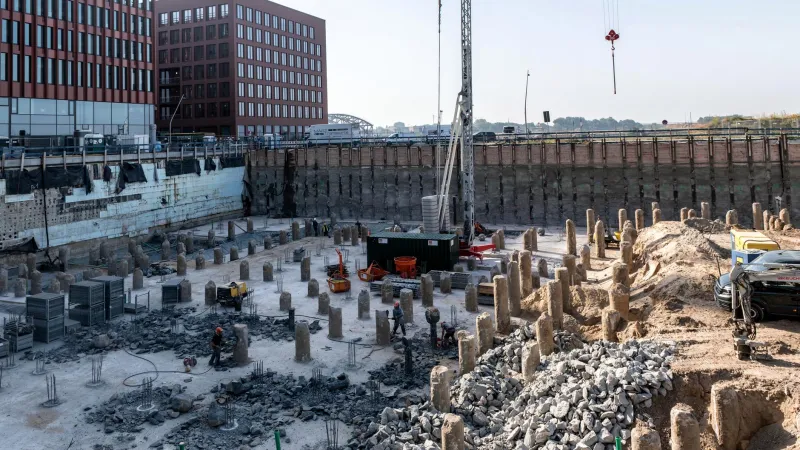
Every experienced contractor has a story that begins the same way: the crew opened a wall, and the wall disagreed with the drawings. In commercial renovation work, the building itself is the primary source of risk — and unlike weather or labor markets, its secrets are entirely discoverable before you commit to a contract price. The question is not whether the building will reveal surprises, but whether you will pay to discover them on your schedule or pay far more to discover them on the demo crew's.
The Economics of Not Knowing
Pre-construction investigation — laser scanning, ground-penetrating radar (GPR), selective coring, utility mapping, and destructive testing of suspect assemblies — typically costs a fraction of one percent of a renovation budget. The change orders it prevents routinely run five to seven figures. A single uncharted post-tensioned slab, severed by a core drill, can trigger structural repair, schedule delay, and liability exposure that dwarfs the cost of having scanned the deck in the first place.
Owners sometimes resist this spend because it feels abstract. It is easier to fund visible progress than invisible intelligence. But consider what a contract price actually represents: a contractor's best estimate of conditions you described, not conditions that exist. Garbage in, contingency out.
Three Failures That Were Entirely Preventable
The riser that wasn't modern. A mid-rise office tenant improvement in the Midwest proceeded on the assumption that the building's plumbing risers matched the 1990s renovation drawings on file. They didn't. A prior — and unpermitted — alteration had rerouted a sanitary line through a chase no drawing acknowledged. Discovery came when the new tie-in didn't match anything. Six weeks of redesign, emergency plumbing scope, and a settlement with the tenant whose floor below took the overflow.
The tendon nobody marked. A retailer converting warehouse space asked its contractor to cut a trench for new drain lines. The slab drawings were "somewhere in the landlord's files" and never surfaced. GPR would have flagged the post-tensioning tendons in an afternoon. Instead, the crew found them with a saw. Tensioned steel does not fail gracefully; the repair involved a structural engineer, a shoring plan, and a very quiet conversation about liability.
The ghost circuit. An office build-out in a converted industrial building kept tripping breakers no one could trace. Selective demolition revealed abandoned, energized wiring from a previous tenant's unpermitted electrical work — live conductors buried above the ceiling grid for years. Beyond the cost, the safety exposure was the kind that keeps risk managers awake.
Ordering the Right Investigation
Not every project needs everything. Match the survey to the risk:
- 3D laser scanning suits projects touching existing structure, MEP tie-ins, or tight tolerances. It produces a dimensionally accurate point cloud that replaces guesswork about column locations, ceiling heights, and interferences.
- GPR and X-ray scanning belong on any slab you intend to cut, core, or anchor into — particularly in buildings where post-tensioning or embedded conduit is plausible.
- Utility locating and mapping is non-negotiable when connecting to existing services. Private utility locating supplements the 811 public-utility process, which stops at the property line.
- Selective destructive testing — opening walls, coring assemblies, sampling materials — resolves what non-destructive methods can only suggest. It is also the only reliable way to surface unpermitted prior work.
- Hazardous materials surveys (asbestos, lead) are legally required in most jurisdictions before disturbance, and skipping them converts a compliance problem into a liability problem.
Making the Findings Count
A survey that sits in a PDF changes nothing. Fold the results into the contract documents themselves: attach the point cloud, annotate the drawings with verified conditions, and allocate the remaining unknown risk explicitly. Where genuine uncertainty persists — a slab you cannot fully map, a chase you cannot open without tenant disruption — price it as a defined contingency rather than pretending certainty you don't have.
Contractors respond to this in kind. A bid developed against verified conditions carries thinner contingency, sharper pricing, and fewer defensive exclusions. The adversarial dynamic that plagues renovation bidding softens when both parties are pricing the same building.
The Building Has Already Testified
The information you need is sitting in the structure right now, indifferent to your schedule and your budget. Forensic investigation is simply the process of taking its deposition early — while it still costs a survey fee instead of a change order. Owners who treat existing-conditions discovery as a pre-construction obligation rather than an optional extra consistently deliver renovations closer to budget, closer to schedule, and with fewer surprises for everyone involved.
Before the demo crew arrives, let the building talk. It has been keeping records longer than you have.